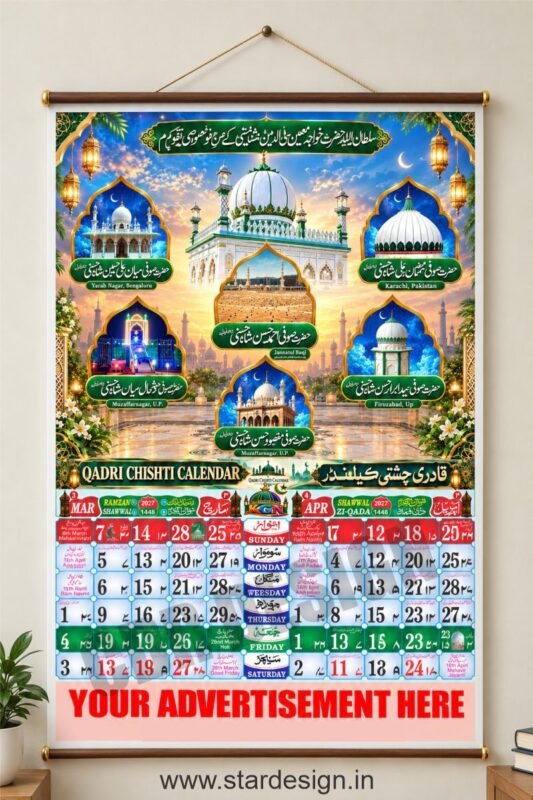
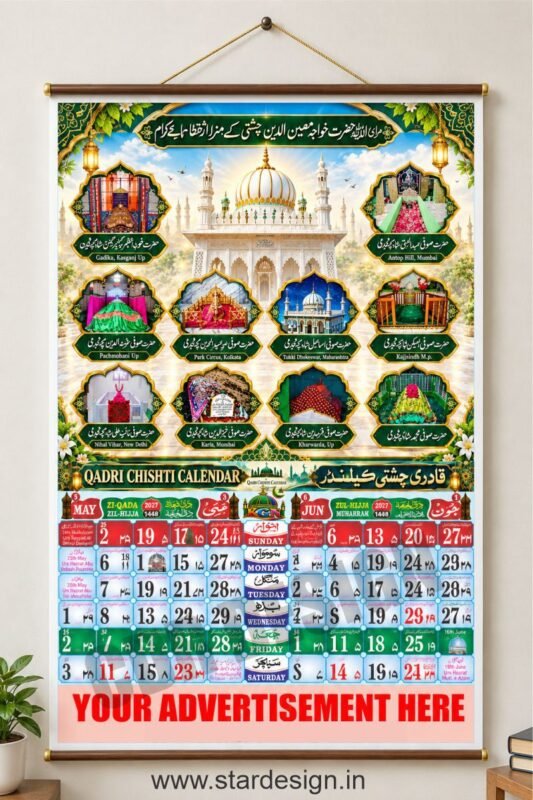
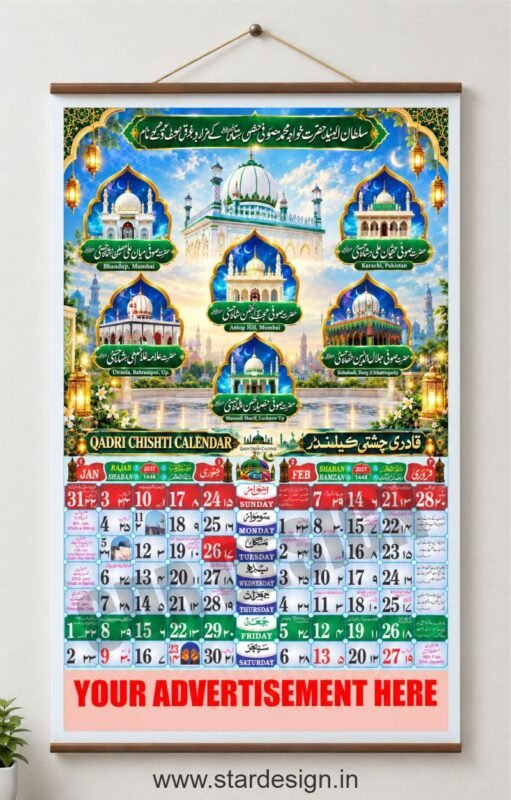
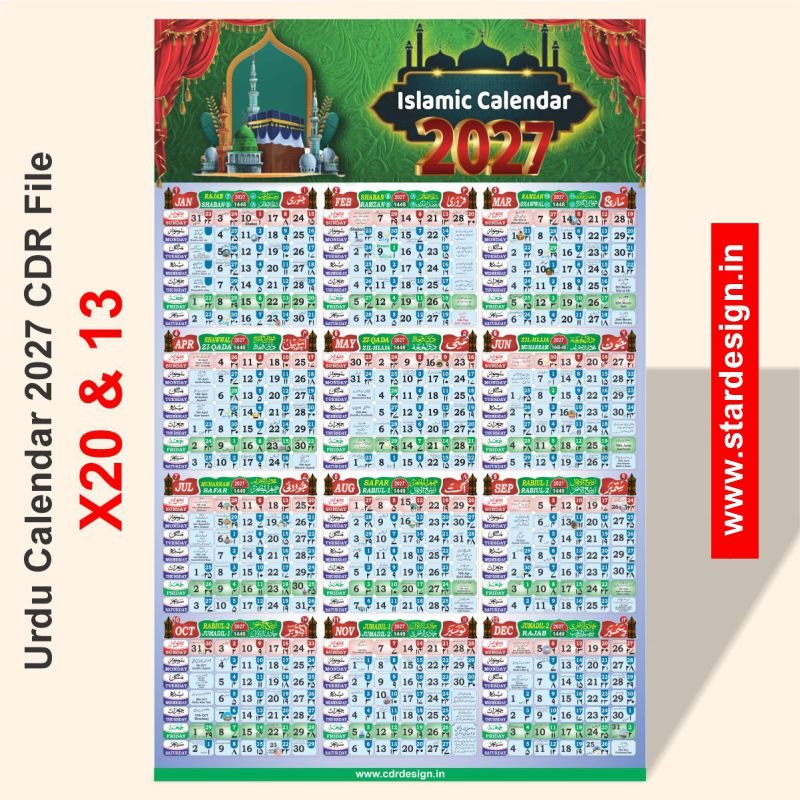
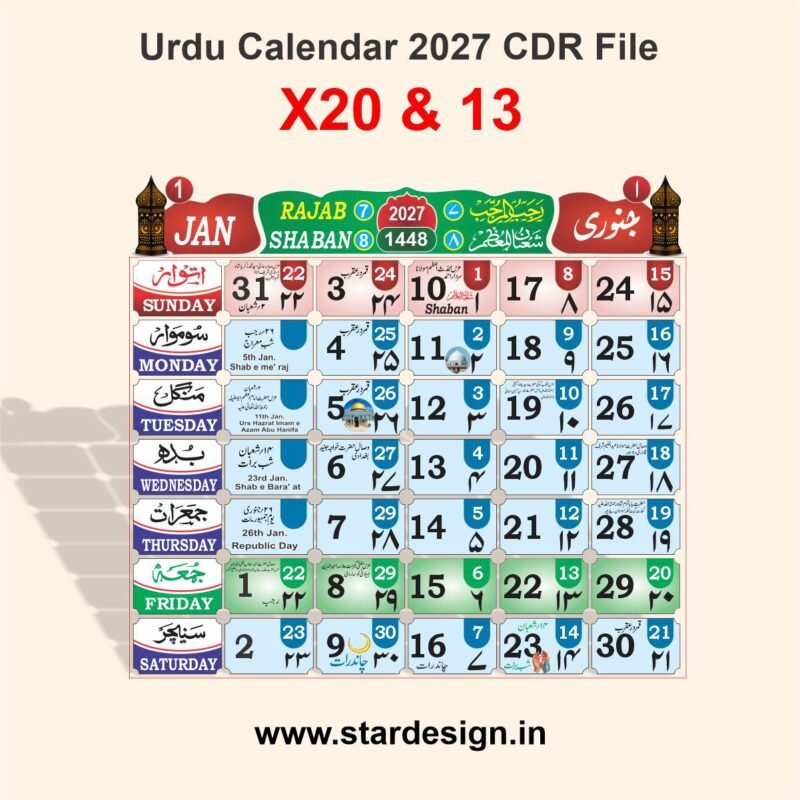
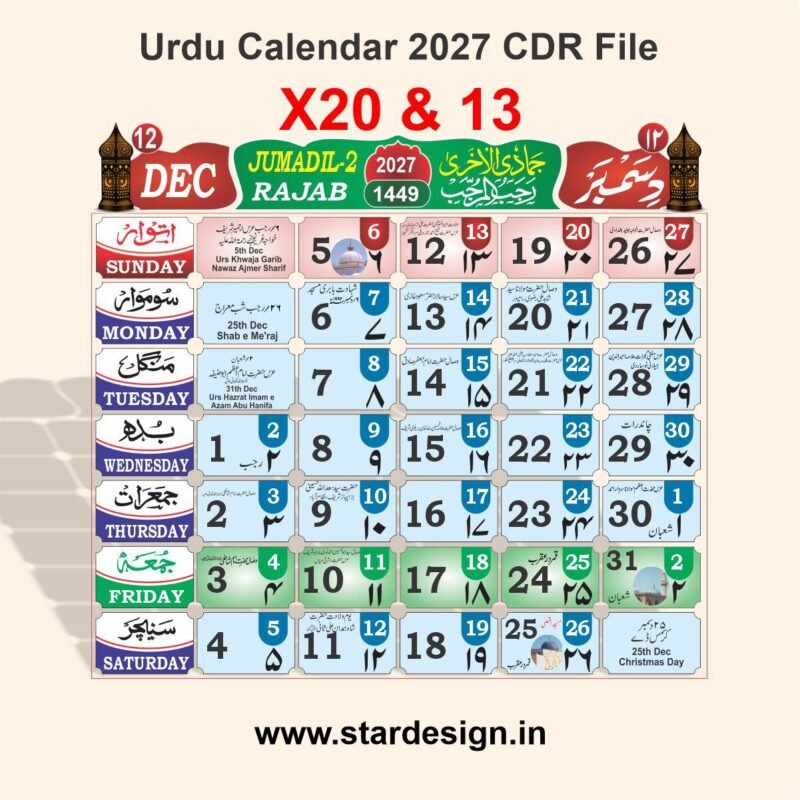
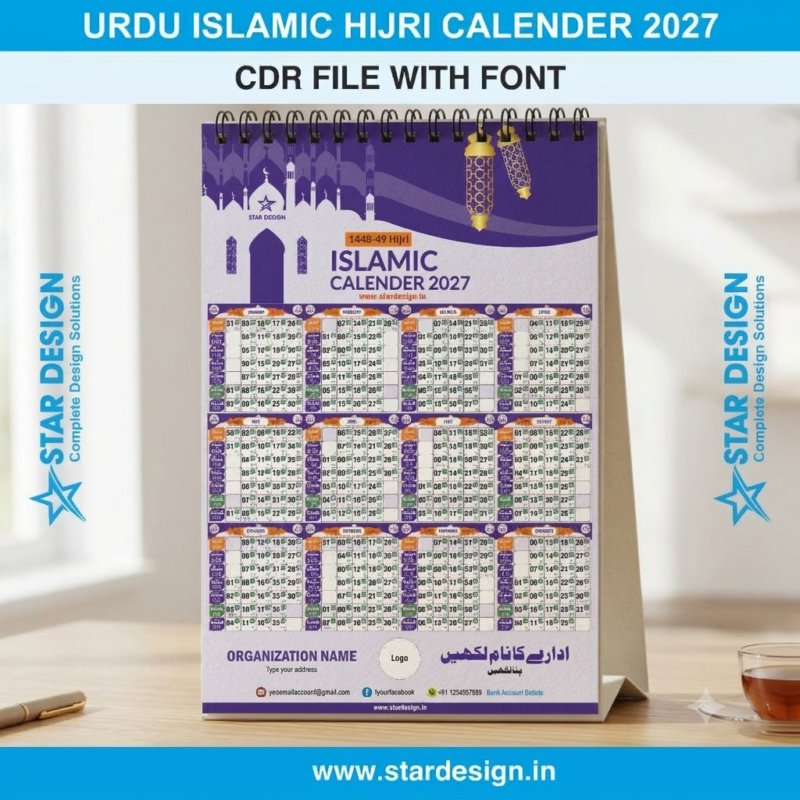
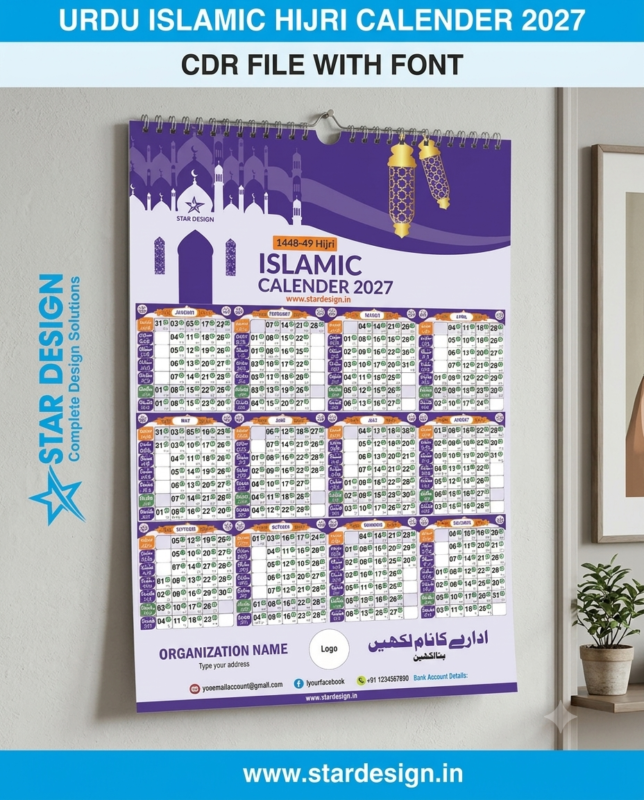
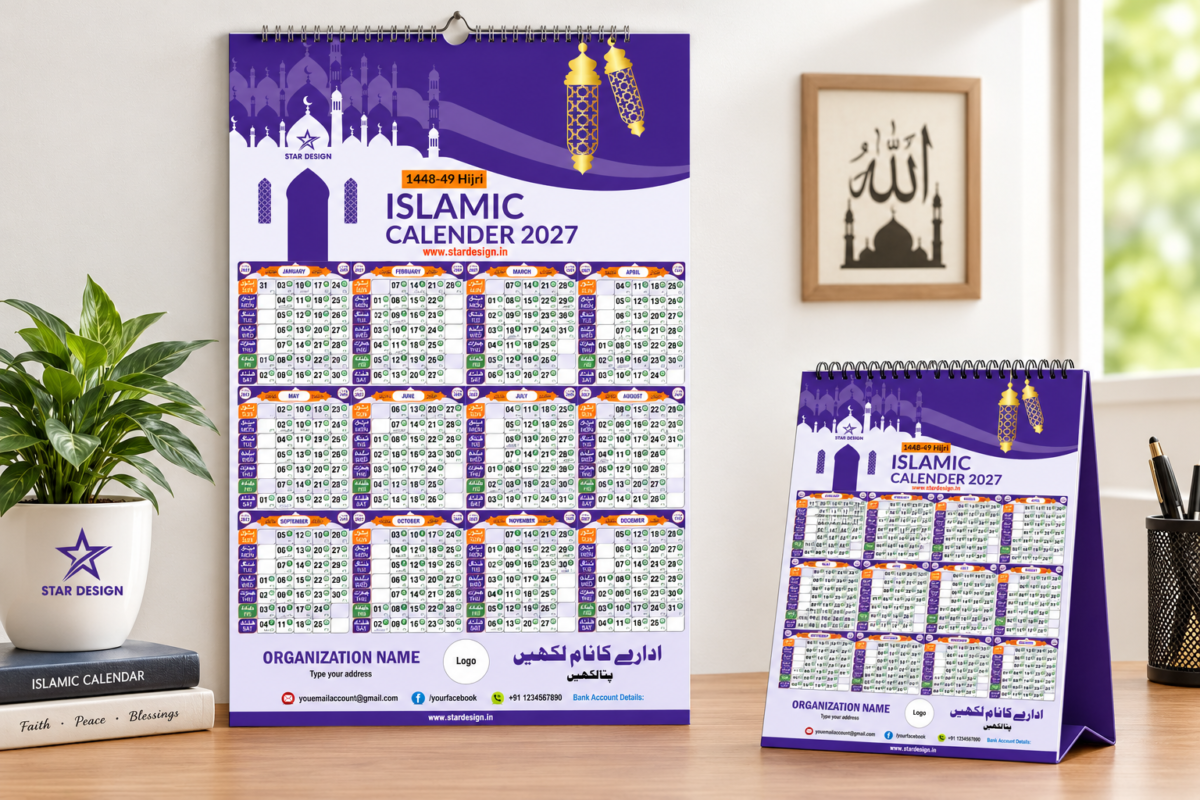
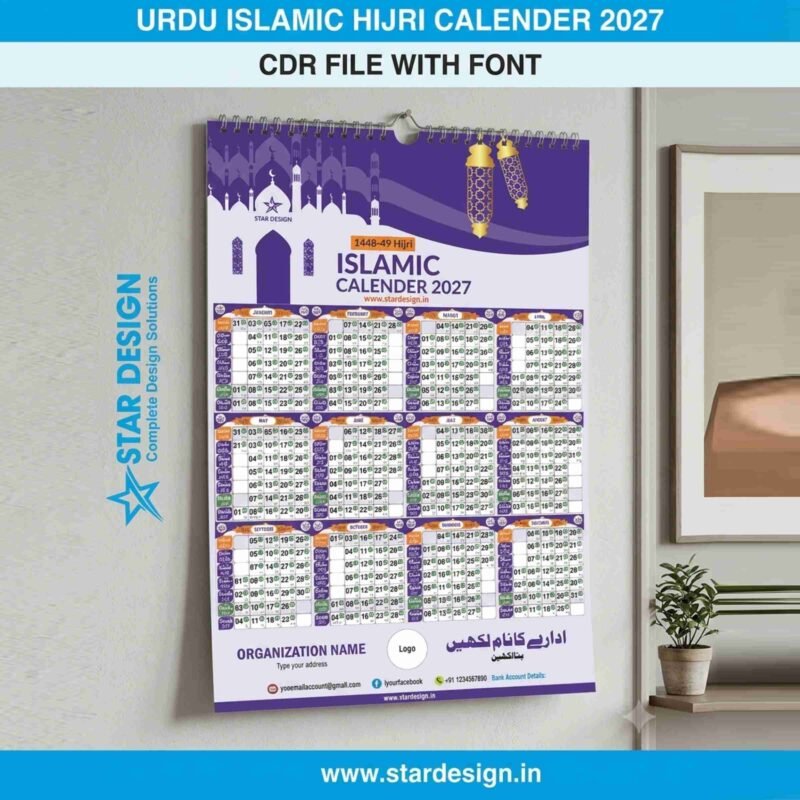
An Urdu Islamic calendar for 2027 should connect the familiar Gregorian year with the Hijri dates used to organize Muslim religious life. Showing both systems together helps readers move easily between civil appointments, school terms, work schedules, and Islamic observances. Urdu labels make the information accessible to readers who prefer the language for dates, month names, and devotional references. Rather than serving only as a date chart, the calendar can act as a practical guide for households, mosques, educators, and community organizations throughout the year.
Its central purpose is to make daily date tracking straightforward. Each Gregorian day should be paired clearly with its corresponding Hijri date, while Islamic month boundaries should be easy to identify. A well-organized layout can also mark significant occasions such as Ramadan, Eid al-Fitr, Eid al-Adha, and other locally observed days. Short notes or restrained symbols may explain the meaning of key observances without crowding the page. Readers can then anticipate fasting, prayer gatherings, family visits, charitable commitments, and community events. Space for personal reminders may further connect the printed calendar to everyday planning, provided that essential date information remains prominent and legible.
Because the Hijri calendar follows lunar cycles, its months do not align with fixed Gregorian dates from year to year. The beginning of a month may depend on the sighting of the new crescent, calculation methods, and decisions made by local religious authorities. Consequently, a date printed for 2027 may differ by one day from the date followed in another region or community. A useful calendar should state this clearly and avoid presenting every observance date as universally final. Readers can consult their mosque or recognized local authority when precise timing matters, especially for Ramadan and the two Eids. This context helps the calendar remain informative, respectful of differing practices, and useful for planning without overstating certainty.
The Gregorian calendar year 2027 begins on January 1 and ends on December 31. The Hijri calendar follows a lunar cycle, with months beginning according to the appearance of the new crescent or a designated calculation method. Because a Hijri year is shorter than a Gregorian year, the two calendars do not begin and end together. A calendar covering all of 2027 will therefore include dates from portions of more than one Hijri year, rather than matching a single Hijri year from its first day to its last.
To prepare an Urdu Islamic calendar, map each Gregorian date in 2027 to its corresponding Hijri date. This mapping should use one clearly stated basis throughout the calendar, such as a recognized astronomical calculation or a trusted calendar issued by the relevant local religious authority. Different methods can produce a one-day difference, particularly around the start of a lunar month. Local moon-sighting practices may also differ from calculated dates, so the calendar should make its chosen method or geographic reference clear to readers.
Pay special attention to month beginnings and year transitions. Do not assume that a Hijri month starts on the same Gregorian date everywhere, or that dates can be converted reliably by applying a fixed number of days. Check the sequence of days across each transition, including the final day of one month and the first day of the next. This is especially important when marking significant observances, since their displayed dates may depend on local announcements. Before sending a calendar to print, compare the complete date grid with the selected source and verify any locally confirmed changes. A transparent, consistent approach helps readers understand how the dates were assigned and reduces confusion when comparing the calendar with other published schedules.
Begin by deciding which country, region, or community the Urdu Islamic Hijri calendar will serve. Hijri dates are based on lunar months, and the start of a month may differ according to local moon-sighting practice, calculation methods, or the decisions of a recognized religious authority. A calendar intended for a particular audience should therefore use a source relevant to that audience rather than combining dates from unrelated regions. If the calendar is for a broad readership, identify the primary location used for its dates and explain that local observance may follow another schedule.
Next, select a dependable reference for the initial date list. This may be an established Islamic calendar organization, a national religious authority, or a trusted local institution with a clear method for determining dates. Check that the source identifies its geographic coverage and whether its dates are calculated in advance or announced after observation. Compare key dates with a second credible reference, particularly when preparing a print edition well before the year begins. Record the source name, publication date, and any relevant method notes so that editorial decisions can be reviewed before the calendar is finalized.
Keep projected dates distinct from dates confirmed through moon sighting. Advance calendars often use astronomical calculations to estimate when a lunar month will begin; these estimates are useful for planning, but may not match an authority’s later announcement. Where relevant, consult local moon-sighting guidance before confirming the beginning of Ramadan, Eid al-Fitr, Eid al-Adha, and other observances. For a calendar printed in advance, label dates as provisional or calculated when appropriate, and avoid presenting them as universally settled. A concise note can state that Hijri dates may vary by location and that users should follow their local authority for confirmed observance. This transparent approach helps readers understand the calendar’s basis, supports accurate expectations, and reduces confusion when dates announced locally differ from printed estimates.
A six-page format can accommodate all twelve Gregorian months by placing two months on each page. Pair months in sequence—January with February, March with April, and so on—so readers can follow the year without searching across distant pages. Within each page, give the months distinct calendar grids, either side by side or stacked vertically. Side-by-side grids suit landscape pages, while stacked grids can provide larger date boxes on portrait pages. Choose the arrangement according to the page dimensions, Urdu script size, and amount of supporting information. Leave a clear gap or dividing rule between the two grids, and avoid placing a month title where it could be mistaken for the neighboring month.
Use a repeatable visual hierarchy on all six pages. Month names should be the most prominent labels, with Gregorian names clearly distinguishable from their Urdu or Hijri equivalents. Place weekday headings directly above the date columns and keep their order consistent throughout the calendar. Make numbered dates easy to locate, using legible type and sufficient contrast against the background. Show Hijri equivalents close to their matching Gregorian dates, but at a smaller size so they support rather than compete with the main numbers. If a Hijri date is subject to local moon-sighting variation, include a concise note explaining that dates may differ by location. Consistent alignment helps readers compare dates quickly.
Balance the amount of information in each month grid. Month lengths vary, and six-week layouts may be needed when the first day falls late in the week; preserve the same cell dimensions rather than shrinking text to force every month into an identical shape. Put observance notes in a reserved area beneath the grid or use discreet symbols with a compact key. Keep notes brief, and ensure that symbols remain distinguishable in print, including in grayscale. Before finalizing the design, review each page at its intended printed size. Check that month boundaries, weekday columns, date pairings, and observances can be scanned at a glance, while margins and gutters leave enough space for trimming and binding.
Urdu calendar design requires more than translating month and weekday labels. Because Urdu is written from right to left, the page structure, alignment, and text direction should support the way readers naturally scan information. Set Urdu labels and explanatory notes to right-to-left direction, while keeping the calendar grid and any left-to-right elements controlled deliberately. A suitable layout helps prevent dates, headings, and annotations from appearing in an unexpected order.
Choose a typeface with complete Urdu support, including the characters and joining forms needed for accurate text. Fonts designed for Urdu or Arabic-script typography generally provide more reliable shaping than fonts with limited language coverage. Check that letters connect naturally, dots remain legible at the intended print size, and the overall style is readable in both dense date cells and larger headings. Use a consistent font system throughout the calendar rather than switching styles without a clear purpose.
Keep the spellings and presentation of Urdu Hijri month names and weekday names consistent across every page. Decide in advance whether labels will use full names or abbreviations, and apply the same approach throughout. Proofread these terms against a trusted Urdu-language reference. Consistency makes the calendar easier to scan and reduces the risk that similar labels will be mistaken for one another.
Gregorian numerals, Hijri numerals, and Urdu text should have clearly defined roles. For example, distinguish the primary date from its corresponding date in the other calendar through position, size, weight, or a restrained color difference. Do not rely on color alone, since the calendar may be printed in grayscale. Test numeral styles and punctuation in context, especially where Urdu text and Western digits share a line, to ensure that readers can identify each date quickly.
Before finalizing artwork, test the actual Urdu content in the software that will be used for layout and export. Some programs handle complex-script shaping or mixed-direction text less reliably than others. Inspect the exported proof, not just the editing window, for broken ligatures, separated letters, misplaced punctuation, or reversed ordering of words and numerals. Review representative pages at print size, then correct any issues before preparing the complete calendar for production.
Begin by mapping each Hijri month to its expected Gregorian placement using a reliable calendar or astronomical calculation, then confirm the method used for the intended audience. A Hijri month begins with the appearance of the new crescent, so its start may differ by a day between regions and communities. Show both calendar systems clearly: pair the Urdu month name with its Gregorian dates, and mark the estimated transition without presenting it as universally fixed. Where space allows, add a brief note that local moon-sighting announcements determine the actual observance.
For 2027, verify the expected placement of major occasions against a current Hijri calendar before preparing the artwork. Ramadan 1448 is expected to begin around February, with Eid al-Fitr around March. The Hajj season and Eid al-Adha are expected around May, while the Islamic New Year, 1 Muharram 1449, is expected around June. These are planning estimates, not guaranteed dates; local sightings and calendar conventions can shift them. Include important dates only when their corresponding Hijri months and weekdays have been checked, and avoid implying that an estimate is a confirmed religious announcement.
Use a restrained visual system to distinguish observances from ordinary dates. A single accent color, a small crescent symbol, or a subtle border can identify Ramadan, the two Eids, Hajj-related days, and the Islamic New Year without overwhelming the page. Apply the same treatment consistently, and ensure symbols remain legible in grayscale and in smaller print sizes. Add a compact legend explaining each color or mark, plus a concise disclaimer about local date variation. If the calendar includes Urdu notes, use clear, familiar wording and adequate spacing so labels do not compete with numerals. Before printing, review month boundaries, spelling, date alignment, and all highlighted observances with a knowledgeable local source. This final check helps keep the calendar practical, respectful, and useful throughout the year.
Begin by creating a six-page document in CorelDRAW, with each page representing two months or another clearly defined portion of the year. Set the intended print dimensions and orientation before placing artwork; confirm whether the printer requires bleed, trim marks, or a specific color profile. Use consistent margins and a measured grid to position month names, weekday labels, date cells, Hijri information, and notes. Keeping dimensions and spacing consistent across all pages makes the calendar easier to scan and simplifies later revisions.
Establish reusable styles for headings, body text, numerals, and Urdu script, checking that the chosen fonts support the required characters and remain legible at printed size. Keep text as editable text rather than converting it to curves during the working stage. This allows corrections to dates, spellings, and spacing without rebuilding the design. Create master elements for recurring headers, footers, page numbers, and explanatory legends, then apply them consistently. Before delivery, verify that any fonts or linked assets are handled according to the printer’s requirements.
Organize the document with clearly named layers, such as background, grid, dates, Urdu text, decorative artwork, and print marks. Lock stable background elements while editing dates, and hide nonessential layers when checking alignment or proofing. Maintain a separate, reviewable date table as the authoritative source for Gregorian dates, Hijri dates, and any observances. Compare this table against every page after importing or entering the data; do not rely on visual layout alone to catch calendar errors. Save the editable project as a CDR source file, using a clear versioned filename. Keep a separate backup before finalizing, and preserve the source even after exporting print-ready PDF files. This workflow protects the design from accidental loss and supports efficient corrections if a review identifies an issue.
Before approving an Urdu Islamic Hijri calendar for 2027, check every page against a reliable calendar source and a defined printing schedule. Confirm that all Gregorian dates from January through December appear once, in the correct order, with no omissions or duplicates. Verify each weekday against the Gregorian date; a single alignment error can shift an entire week’s layout. Record the source and method used for Hijri conversion, since lunar dates may vary according to the calendar authority, region, or moon-sighting practice selected.
Review every Hijri date individually, paying particular attention to the beginning and end of each month. Check that month names, date numerals, and transitions follow the selected Islamic calendar consistently, including any month that spans two Gregorian pages. Ensure that observances are assigned to the intended Hijri dates and are clearly distinguished from ordinary entries. Where dates may differ between authorities or local moon-sighting decisions, add a brief, visible note explaining the calendar basis rather than implying universal certainty.
Urdu proofreading should cover spelling, punctuation, numerals, honorifics, and consistent forms of month and observance names. Ask a fluent Urdu reader to inspect the proof for natural language and typographical errors, and have someone familiar with the chosen Islamic calendar verify conversions and religious dates. Check right-to-left reading order throughout: text, numerals, date pairings, labels, and page navigation should remain unambiguous in both digital files and printed proofs. Inspect exported pages as well as the original design, because font substitution or layout changes can affect Urdu rendering.
Assess accessibility at actual print size. Use strong contrast between text and background, readable type, adequate line spacing, and sufficient room around dates. Gregorian and Hijri dates should be visually distinct through clear labels, placement, or restrained styling—not color alone. Avoid crowded cells and overly fine details, especially for older readers. Print a sample at final size and review it under ordinary lighting before authorizing the full run. A final checklist signed by both reviewers can document corrections, confirm that updates were carried through every page, and reduce the risk of errors reaching readers.
Before sending a six-page Urdu Islamic Hijri calendar to print, confirm that every page uses the same finished dimensions and orientation. Check the document setup in the editable CDR file, then compare page edges, alignment, and content placement across all six months or sections. Keep text, dates, and important symbols inside the safe margin so they are not lost during trimming. If the printer requires bleed, extend background colors or images beyond the trim line by the specified amount; do not extend essential text or calendar details into that area. Ask the print provider for its preferred page size, bleed, color, and export settings rather than relying on assumptions.
Inspect image quality at actual print size. Logos, decorative artwork, and photographs should have sufficient resolution for the intended output, with raster images commonly prepared at 300 dpi where appropriate. Review Urdu typography carefully: ensure fonts are embedded or converted to curves according to the printer’s workflow, and verify that right-to-left text, ligatures, diacritics, and numerals display correctly. Export a print-ready PDF using the requested standard and settings. Open the PDF on a separate device or in another viewer, and inspect each page at high magnification as well as at normal reading size. Compare it with the CDR source to catch missing fonts, substituted glyphs, shifted Urdu lines, altered spacing, unexpected color changes, or clipped borders and elements.
Keep the editable CDR file as the production master and retain a final PDF copy for proofing, sharing, and printing. If possible, request a physical proof before approving a full print run, especially when small Urdu text or fine decorative details are involved. Include clear identification of the calendar’s intended region, such as Pakistan or a particular locality, and state the date-calculation basis used. Hijri dates may differ because communities follow local moon sighting, a national announcement, or a calculated calendar method. A concise note on the calendar or its accompanying description helps readers interpret such differences, set expectations for month beginnings, and use the dates appropriately for local observance.